


Everything else is the echo. What a retired rheumatologist found when he went back to the studies his own field never read to patients, and why you were never "imagining it."



Before I tell you what the research says, I want to tell you why I spent 27 years of my life inside this field, and why I'm writing this instead of playing golf. It matters, for what comes next.
I'm a rheumatologist. Retired now. Over 27 years I sat across from more than 8,000 women with widespread pain, crushing fatigue, and a fog so thick they lost words mid-sentence.
And when their tests came back normal, I wrote one word on their chart.
Fibromyalgia.
It sounds like an answer. It isn't. It's what we write when we've run out of places to look. A word that sounds like a solved mystery, handed over with an antidepressant and "see you in six months."
If no one has ever apologized for that, let me be the first. Because the research that finally explained it was sitting in my own specialty's journals the entire time. Nobody read it to me. Nobody read it to you.
And the one place it points to is a place no standard exam was ever designed to treat: your neck. Before you ask how a neck could explain pain in your hips, your hands, your sleep and your memory, that question is this whole article. By the end of it you will know exactly why the pain everywhere else is the echo, and the neck is the source.
The Night It Came Home
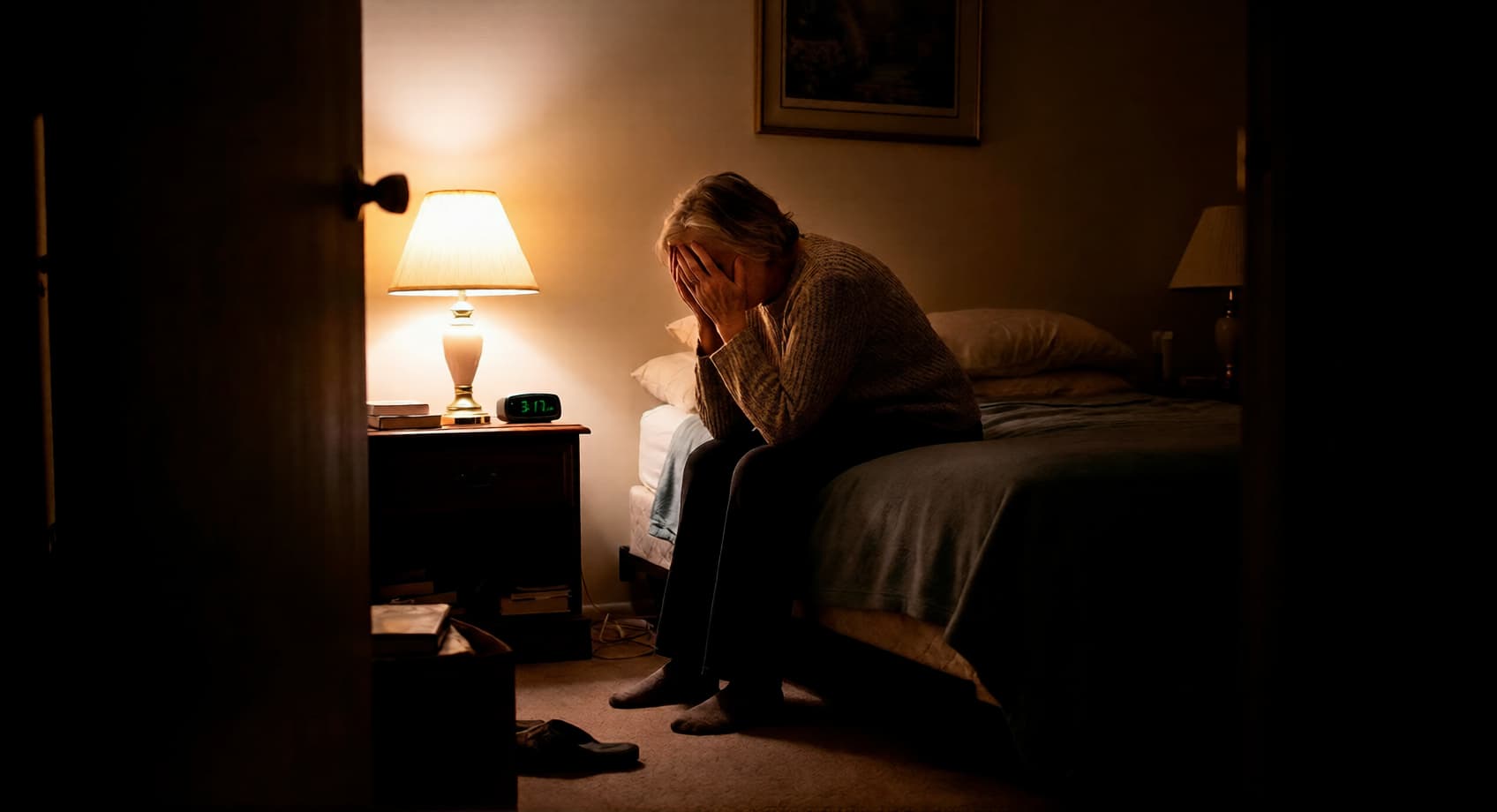
Twenty-one years into my career, my wife Carol started describing the same symptoms I had been filing away on other women's charts for two decades.
Pain that moved without a pattern. Mornings spent scanning her body before her feet touched the floor. Fog so thick she would lose a word mid-sentence and laugh it off, then cry about it later.
For ten years, I watched her run the same gauntlet my patients ran. Four specialists. Normal bloodwork. Normal imaging. Words like stress, anxiety, perimenopause.
Then one afternoon, after the fourth specialist suggested she try journaling, I sat with her in the car. And it hit me.
I had written that same recommendation, in different words, on thousands of charts.
Everything my training told me to do had done nothing for the woman I love. And if the protocol was useless for her, it had been useless for every woman I had ever handed it to.
So I did what I should have done twenty years earlier. I stopped reading drug trials, and I started reading the research my field had published and never used. What I found is what I did with my retirement.
What the Research Actually Says
Three studies. All peer-reviewed. All published in journals my colleagues subscribe to. None of them ever mentioned in a fifteen-minute visit.

Read those three together and the picture is hard to unsee. The exam points at the neck. The lab shows that losing deep sleep produces the disease. And the neck, when injured, produces the disease thirteen times more often. Nobody connected them. That's what this article does.
The Place No Exam Was Designed to Look At
Here's what those eight points are sitting on.
The small, deep muscles at the base of your skull don't just hold your head up. They sit exactly where your nervous system decides whether you're safe enough to rest.
When they clamp, from a screen, from stress, from an old injury, from nothing you can point to, and stay clamped for years, your body never gets the all-clear. It stays on guard all night. And a body on guard never drops into the deep sleep where it repairs itself.
You can sleep ten, twelve, fourteen hours and wake up like you never slept. The repair shift never clocked in.
Nobody is waking you from a chair in a Toronto lab. Your own neck is doing it, every night.
And a body that never repairs hurts everywhere. Not in one place. Everywhere, and never the same place twice. The pain "moves" because it isn't coming from where you feel it. It's the echo of one clamp, turning up the volume on every signal in your body.

What It's Costing You, Measured
This is the study I want you to remember, because it's the one that turned "learn to live with it" from advice into a bill.

Read that the way I had to read it, as a husband and not as a doctor. Nine and a half years, for every year you're told to live with it. That's what "learn to live with it" actually costs. It isn't patience. It's a meter.
Let me say what that number means, because I've watched people misread it. "Brain aging" doesn't mean your brain is dying. Your heart keeps you alive, not your gray matter. Gray matter is the tissue you think with. When there's less of it, nothing stops. It just runs slower. The word that won't come. The name you knew a second ago. The recipe you've made two hundred times and suddenly have to read. That's what a brain that's aged faster than the calendar feels like from the inside. Not death. Fog. So if you've had this thirty years and just calculated a brain older than the country, you're not dying, and you're not crazy. You're foggy, exactly like the study predicts.
And the meter runs every night the night shift doesn't clock in, because deep sleep is exactly when the brain gets cleaned and repaired. Skip it for years, and the scanner shows what McGill saw. Not because the brain is diseased. Because the crew never came to work.
Here is the part of that research nobody quotes. Other scanner studies found the gray matter comes back when the pain goes. The brain isn't a bill you can't reverse. It's tissue that repairs, once you let it sleep. The meter runs both ways.
Every Symptom Finally Makes Sense
Once you know where the clamp is, the "random" list your doctors couldn't connect stops being random. Not a hundred separate problems. One problem, echoing in a hundred places.
Why it happens. A body on guard turns the volume up on every signal it receives. Ordinary touch arrives at the brain amplified. Your skin isn't damaged. The volume is.
Why it happens. Ten hours in bed, zero hours of repair. The clamp keeps the alarm on all night, so the deep, restorative stage never starts. You're not tired. You're unrepaired. Toronto proved it: take deep sleep away from a healthy woman and she gets this.
Why it happens. You're taking stock of damage nothing repaired overnight. It's worst in the morning because the night shift is when the repair was supposed to happen.
Why it happens. The brain clears its waste and rebuilds itself during deep sleep, through a drainage system that runs down through your neck. A clamped neck is a closed drain. The waste backs up into tomorrow's fog, and the McGill meter runs. The fog isn't a failing mind. It's a mind that never gets its shift.
You Can Probably Name the Moment Yours Started
Most women with fibromyalgia can. A car accident. A surgery. A pregnancy. A virus that never fully cleared. A year of unrelenting stress. A childhood the body never let go of.
For decades, doctors treated those triggers as coincidences. They weren't. Every one of them is a reason for the muscles at the base of the skull to clamp and stay clamped. Different events. Same place.
And if you can't name a moment, you're not the exception. Most of the women I treated never had an accident. They had years of looking down, of bracing, of a neck that slowly forgot how to let go. The injury study shows where it lives. You don't need the injury. You just need the exam you already had.
Why Nobody Was Trained to Look There
Here is the honest answer to the question you're asking, and it isn't a conspiracy.
A rheumatologist is trained to diagnose fibromyalgia by pressing those eight points, and trained to treat it with medication. Nobody, in medical school or residency or twenty-seven years of conferences, is trained to do anything about the muscles they just pressed.
So we press them, write "everywhere," and reach for the prescription pad. Every medication we hand you works downstream, on the signal, after it has already been amplified. It can quiet the alarm for a few hours. It cannot run one minute of the night shift.
That's why the Lyrica helps, then the dose climbs, then it climbs again. Twenty pounds and a fogged memory later, the clamp is still there, doing what it does every night.
It's not that you failed the treatments. The treatments were aimed at the wrong address. Nobody was treating the clamp. They were medicating the echo.
It's Not a Disease. It's a Deficiency.

Once you read those four studies together, there's a conclusion my profession will never say out loud, so I'll say it.
Fibromyalgia is not a disease. We treat it like one, and we manage it like one for life.
But it's a deficiency. A body that hasn't run its repair shift in years, because the muscles at the base of the skull never let it. And no pill in the world fixes a deficiency. You give the body back what it's missing, and it repairs itself. Toronto's volunteers proved that in days.
That's the opening for a genuinely different approach.
What a Clamped Muscle Actually Needs

After what happened to Carol, my son Daniel, a biomedical engineer, and I spent two years on one question: what does a muscle that's been clamped for years need in order to let go and stay let go?
The answer is three things, at the same time.
It has to be released . Deep, targeted pressure on the clamped points at the base of the skull, deeper than any thumb, tennis ball or massage gun reaches.
It has to be refed . Clamped tissue has strangled its own blood supply; sustained warmth floods it with blood and oxygen and reopens the drain.
And it has to be recharged . A muscle that's been clamped for years has run its cells down to empty. Release it and warm it, and by morning it clamps back down, because the cells still don't have the energy to stay open.
That third piece is the one nothing in your medicine cabinet does. Medical-grade red light, at two exact wavelengths, 660 and 850 nanometers, penetrates the tissue and switches the cells' energy production back on. It's the same light NASA studied in the early nineties, and one of the only technologies with published studies in fibromyalgia patients .
Pressure. Warmth. Red light. In that order, together, the clamp lets go, and stays let go.
This combination already exists, inside high-end clinics. One session runs about $300, and you need it daily, because the clamp re-tightens every night. That's $9,000 a month. It's why you've never seen it, and why the women who can afford it seem to live normal lives while you were offered Lyrica in a six-minute visit.
So We Built It for the Couch
A clinic machine is the size of a refrigerator because nobody ever bothered to make it small. We spent two years doing exactly that.
Every diode inside our device is microscopic, engineered at the exact power needed at 660 and 850 nanometers. The massage phase holds constant, targeted pressure on the clamped points, deeper than any pair of hands, and it never gets tired. The warmth phase floods the tissue, so the clamped nerves soften and the drain reopens.
The device is called the RedLight Pro . The first prototype sat on our kitchen table. Carol was the first person on earth to use it.


The Numbers So Far
Since we partnered with Revive Care to manufacture it, more than 11,500 women have used the RedLight Pro. In a survey of users, here is what they reported.
What Happened to My Wife
Night one, Carol used it for fifteen minutes on the couch, then went to bed. The next morning she slept until 6:40. She had not slept past 5 a.m. since 2019.
Week one, she stopped doing the inventory. She opened her eyes and simply got up. No scanning. No negotiation with her own body.
Week two, she was sleeping through the night. Full, deep, boring sleep. The kind you forget exists.
Week three, she made pancakes on a Tuesday and called our daughter. They talked for an hour. She never lost a word.
Week four, she booked a flight to see her sister. A suitcase. Plans. All the things fibromyalgia had taxed out of her life, she started taking back, one by one.
The diagnosis is still on her chart. The life that came with it is not.
Safe With Your Current Medications
The RedLight Pro doesn't interact with anything you take. You don't have to stop or change any medication to use it. Most of the women who wrote to us kept their prescriptions exactly as they were and simply added the 15 minutes in the evening, then tapered down over time with their doctor as the nights came back.
If you use light-sensitizing medication or have a condition affected by light, check with your doctor first.
Why Starting Sooner Matters
Timing matters more with this condition than most women realize, and it's the reason I don't tell anyone to think about it for a few months.
An alarm that rings long enough eventually stops needing a reason. The nervous system learns the pain. Researchers call it central sensitization : the wiring itself changes, and the amplified signal becomes the new normal even when nothing is pressing the clamp anymore.
The women who came to me after a decade of refills took the longest to bring back. Not because the clamp was different. Because there was more wiring to undo. And the McGill meter does not pause while you decide: nine and a half years of brain for every year, most of a year for every month .
I watched my own wife walk right up to that line. Wherever your neck is today, one year in or fifteen, it is the easiest it will ever be to release.
There is one more thing worth knowing before you go, because it is the reason I feel comfortable telling you to try this.
Take 90 days. Use it every evening, fifteen minutes on the couch. Most women feel the clamp release in the very first session, around minute six. The full nights, the mornings without the inventory, the word that comes on the first try, build over two to four weeks as the night shift comes back online.
If it does not work for you, we do not want your money. One short email, and within 48 hours the refund is back in your bank account. No shipping the device back. No forms to fill out. No conditions. You keep it.
You have been through enough already.
From Women Who Had Given Up on Feeling Better
Everything I've told you about my wife is also what women who found the RedLight Pro on their own have been reporting. Here are four of them, in their own words.


Small clinical batches
The RedLight Pro is not always available. Here is why.
It is built in small clinical batches so every unit passes the same checks before it ships. When a batch sells out, the next one takes several weeks to produce, and women already on the protocol are placed ahead of new customers for restocks.
But if it's in stock when you read this, that's your window.
You were never crazy. It was never in your head. It was your neck.
2. Moldofsky H, et al. Musculoskeletal symptoms and non-REM sleep disturbance in patients with "fibrositis syndrome" and healthy subjects. Psychosomatic Medicine, 1975.
3. Buskila D, et al. Increased rates of fibromyalgia following cervical spine injury: a controlled study of 161 cases of traumatic injury. Arthritis & Rheumatism, 1997.
4. Kuchinad A, et al. Accelerated brain gray matter loss in fibromyalgia patients: premature aging of the brain? Journal of Neuroscience, 2007.
5. Xie L, et al. Sleep drives metabolite clearance from the adult brain. Science, 2013.
6. Meta-analysis of photobiomodulation therapy in fibromyalgia patients. Lasers in Medical Science, 2019.
7. Gracely RH, et al. Functional magnetic resonance imaging evidence of augmented pain processing in fibromyalgia. Arthritis & Rheumatism, 2002.