


Retired Orthopedic Surgeon: "I Operated On 3,000 Knees. Then My Wife Got Arthritis. This Is What The Protocol Will Never Tell You."
If you have been on cortisone shots, NSAIDs, and a compression sleeve and the pain keeps coming back faster each round — you are not failing the protocol. The protocol is the failure. And nobody in the system has the economic incentive to tell you why.

I Operated On 3,000 Knees. Then I Operated On Nobody.
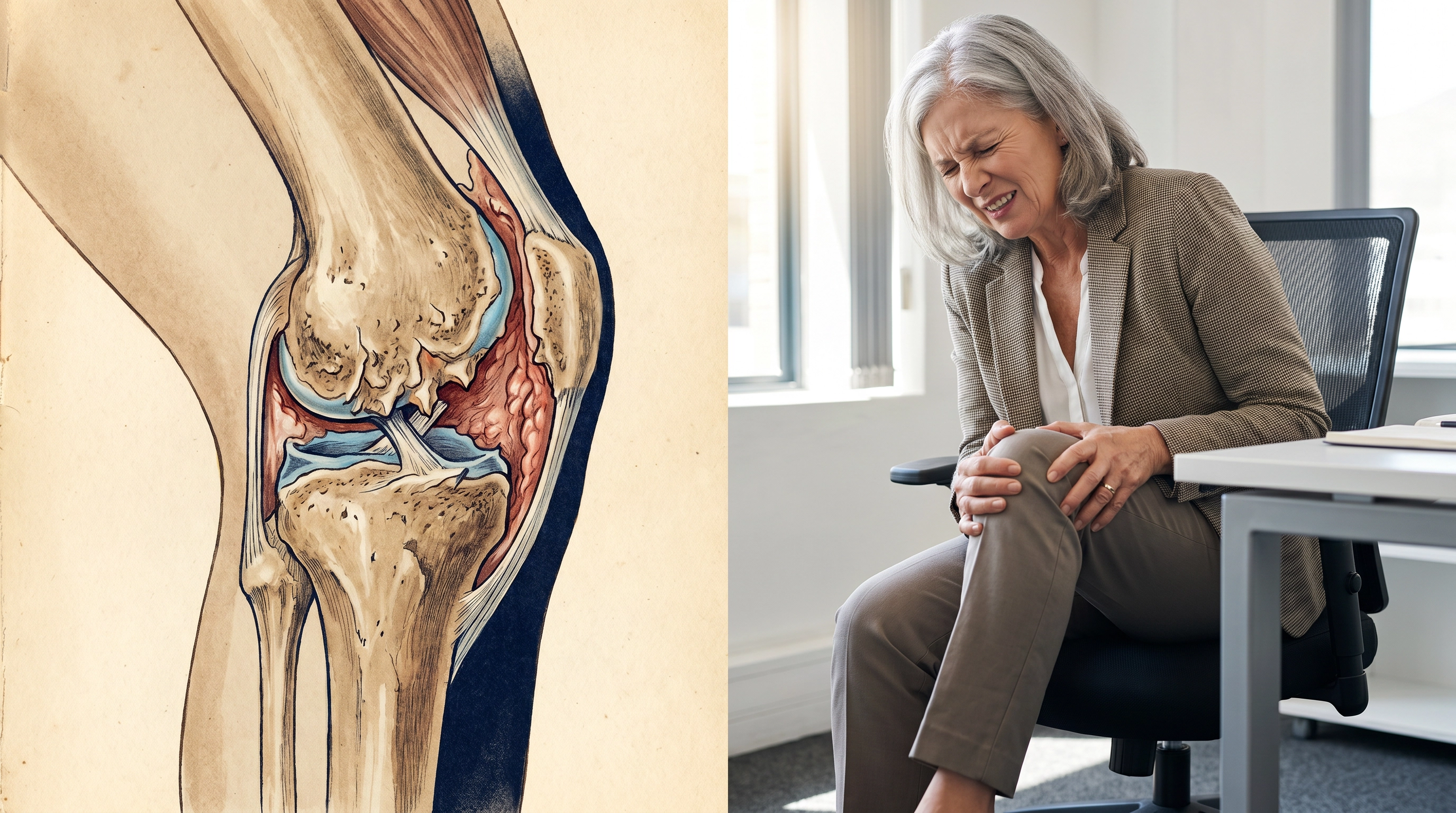
My name is Walter Hayes.
I am 78 years old.
I was an orthopedic surgeon for 42 years.
I performed over 3,000 knee procedures.
And I cancelled my own wife's surgery three days before they were going to cut her open.
Forty-Two Years Of The Same Protocol
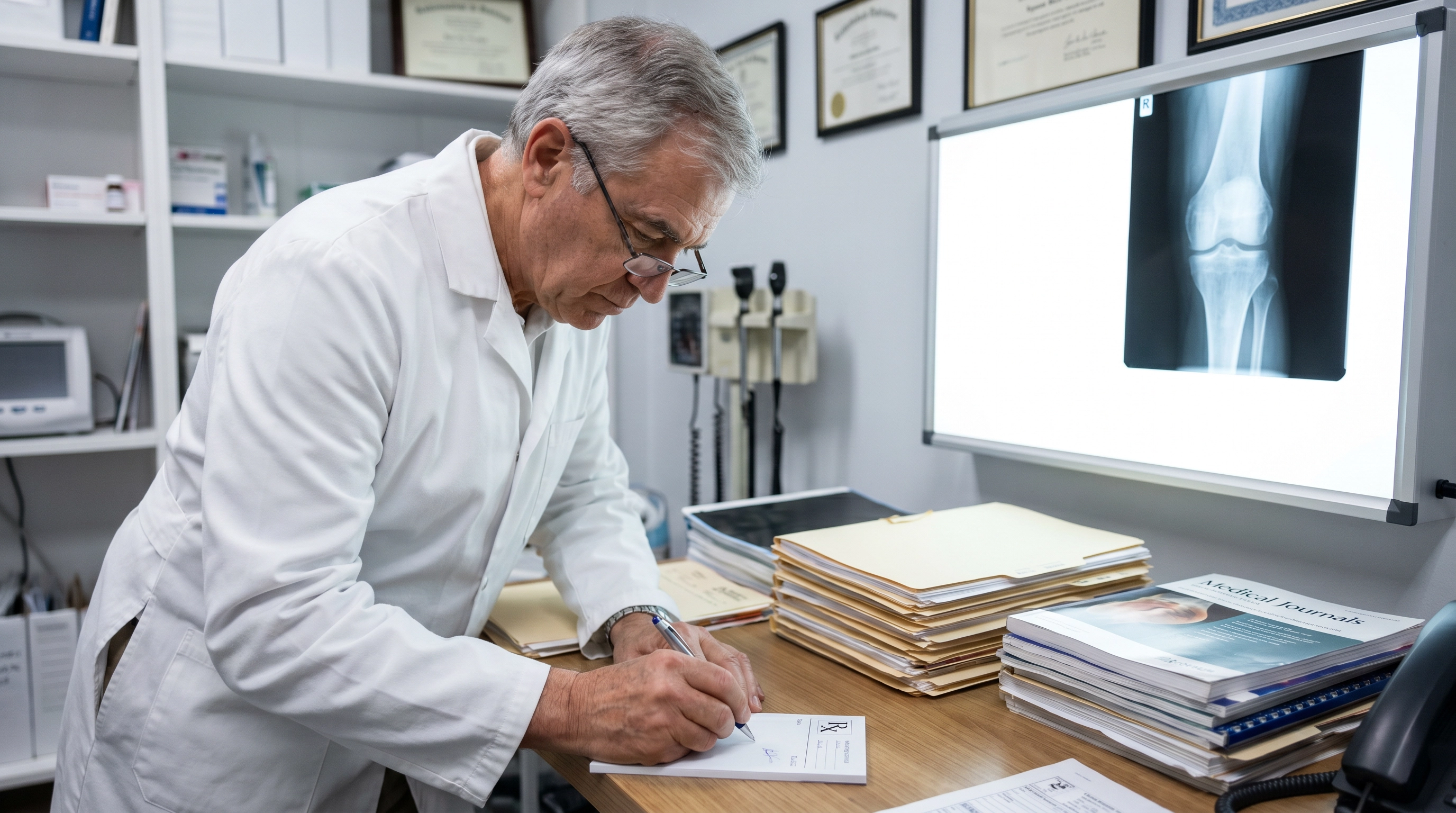
I followed the standard of care exactly the way it was taught to me in 1981.
Patient comes in with knee pain. X-ray shows arthritis.
Prescribe ibuprofen. Bill insurance.
Six months later, pain worse. Recommend a cortisone shot. Bill insurance $1,600.
First shot works for three weeks. Then four weeks turns into two.
Tell the patient their body is getting used to it.
Third shot fails. Recommend total knee replacement. Bill the insurance $43,000.
I did this for 42 years.
I was good at it. The American Academy of Orthopaedic Surgeons gave me an award in 2011.
I never once questioned the protocol.
Until my wife had to go through it.
Margaret. 67. Three Years Of My Own Recommendations.

My wife is named Margaret. She is 67.
The pain started in her right knee in 2021.
I told her ibuprofen, 600mg three times a day. The same prescription I had written 10,000 times.
She took those pills with her morning coffee for fourteen months.
When the pain got worse I sent her to my colleague at the practice.
He scheduled her TKR for March 11th.
I told her it was the right call. I had performed that exact surgery on hundreds of women her age.
Then she stopped sleeping.
I would wake up at 3am and find her on the edge of the bed, scrolling Reddit threads on r/Kneereplacement.
Reading horror stories. Foot drop. Frozen scar tissue. Pain ten times worse than before surgery.
She would look at me and say I trust you.
And then she would not be able to look at me.
The Look That Stopped Me

I had spent 42 years on the surgeon's side of that conversation.
The look in her eyes was the look I had seen across my desk thousands of times.
Patients I had told yes. Patients I had reassured. Patients I had scheduled.
Some of them came back five years later with the metal failing.
I had told them sometimes TKR does not always work. The same line my own teacher had given me to use in residency in 1979.
For the first time in 42 years I sat at my kitchen table and asked myself a question I had never asked.
Was the protocol actually working?
I did not have an answer.
I had statistics. Outcomes. Medicare codes.
I did not have an answer.
So I went back to the literature.
What I Found That Night
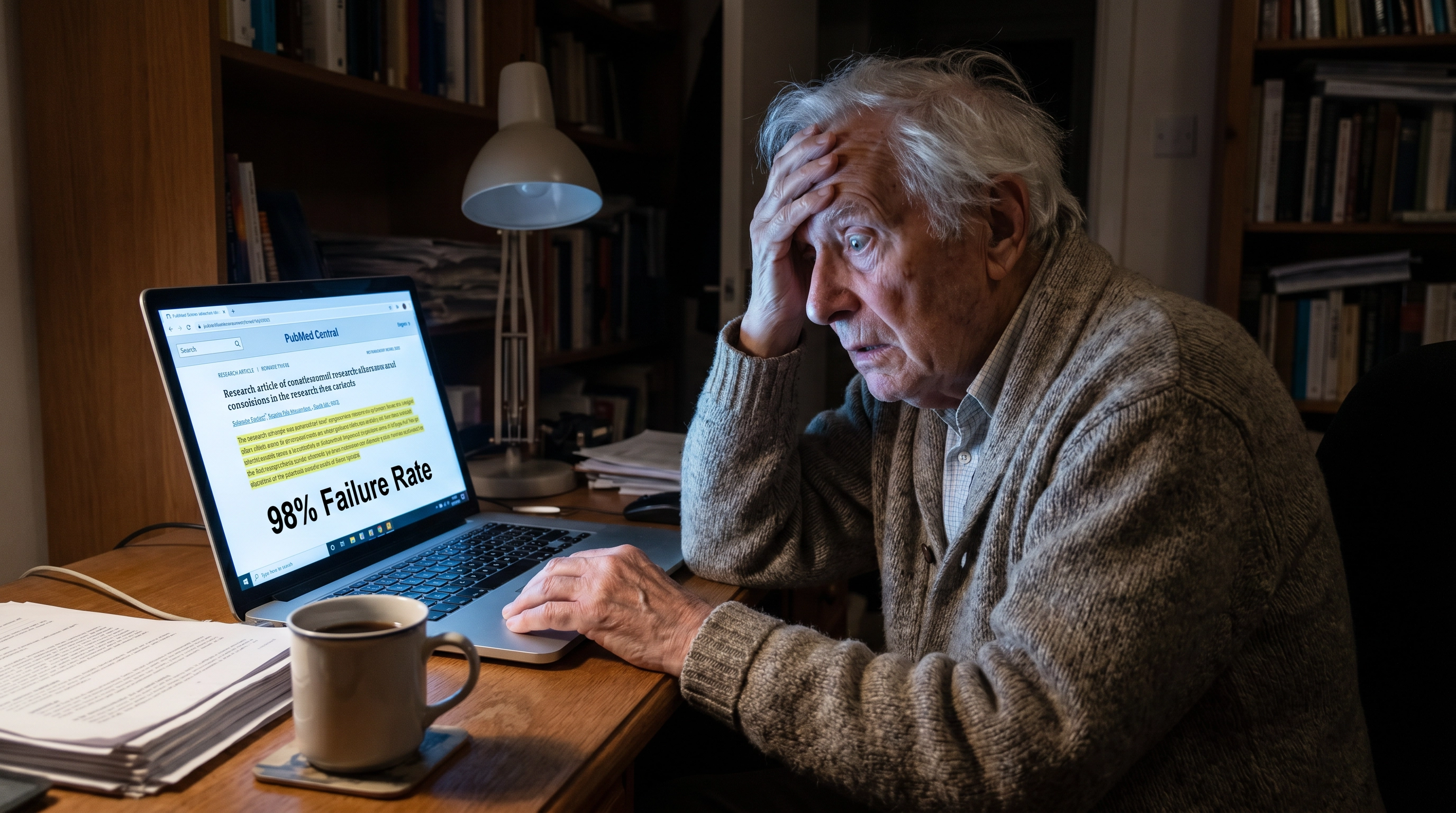
I went to PubMed at midnight.
A 2024 prospective study followed long-term NSAID users for four to five years.
People taking ibuprofen and naproxen for knee arthritis the way I had told Margaret to take them.
They had a 313% higher likelihood of needing total knee replacement than people who did not take them.
Three hundred and thirteen percent.
The pills I had prescribed 10,000 times in 42 years were tripling the odds of the surgery I then performed on those same patients ten years later.
Then I found the 2022 RSNA paper. MRI follow-up at four years on long-term NSAID users.
Joint inflammation worse. Cartilage quality worse.
The pills were not slowing the disease. They were accelerating it at the cellular level.
Then I found the BMJ paper from 2017. An international panel had strongly recommended against arthroscopic knee surgery for nearly all patients with degenerative knee disease.
700,000 of those surgeries are performed in the US every year anyway.
I had performed at least 400 of them.
Then I found the part that broke me.
What Is Actually Happening Inside Your Knee
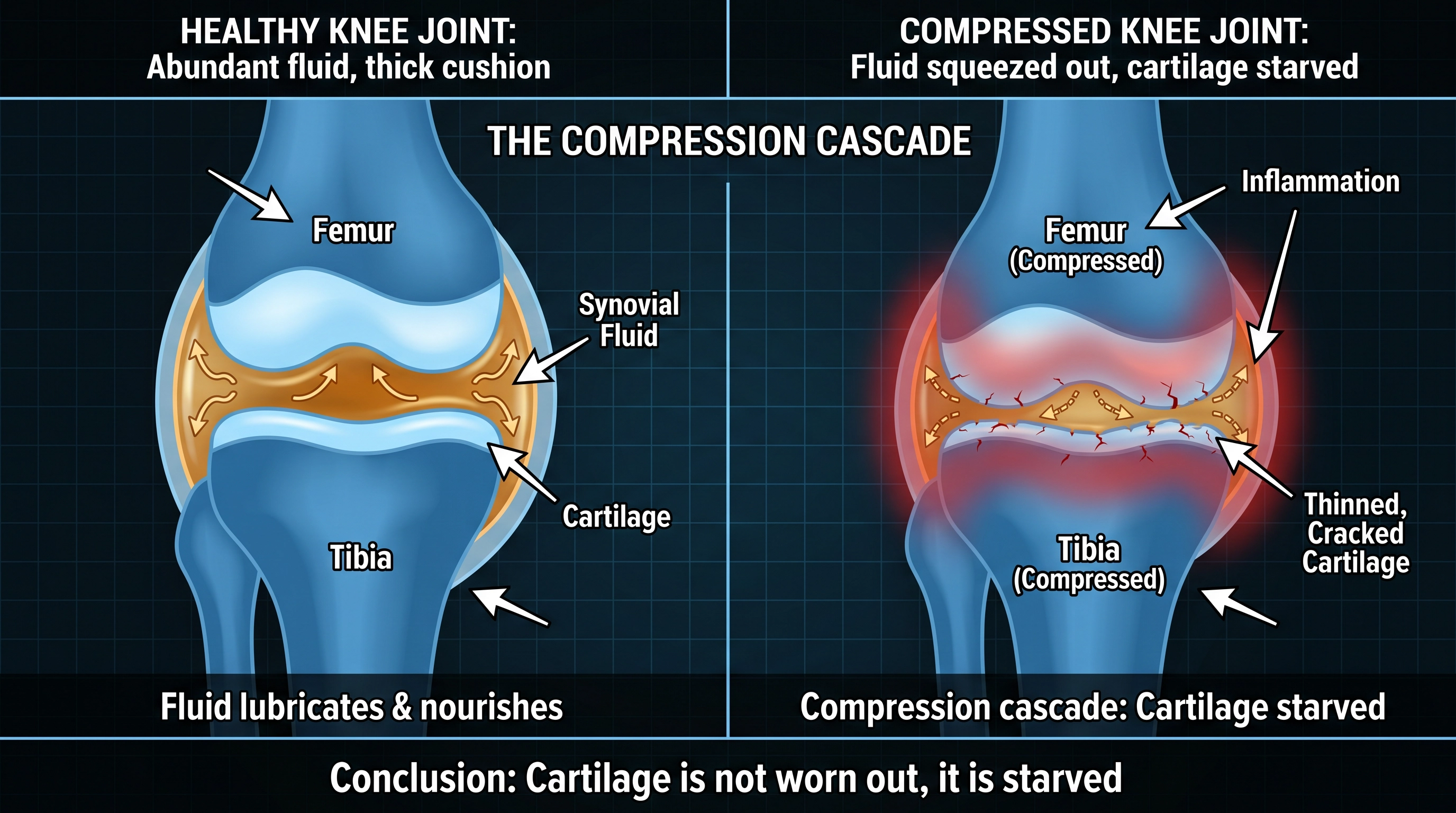
Inside your knee there is a fluid called synovial fluid.
It feeds the cartilage.
Cartilage is the only tissue in your body that does not have its own blood supply. It eats by being bathed in this fluid every time the joint moves.
When weight presses on the joint all day, that fluid gets squeezed out of the loaded zone.
The cartilage stops getting fed.
Not worn out. Starved.
A starved tissue releases stress signals. The body responds with inflammation. The inflammation makes the joint swell. The swelling adds pressure inside the joint. More compression. Less fluid getting in.
The cartilage starves faster.
That is the cycle.
The paper called it the compression cascade.
I traced what I had been doing to my own wife for three years against that cycle.
Every step had made it worse.
Why Everything I Prescribed Made It Worse
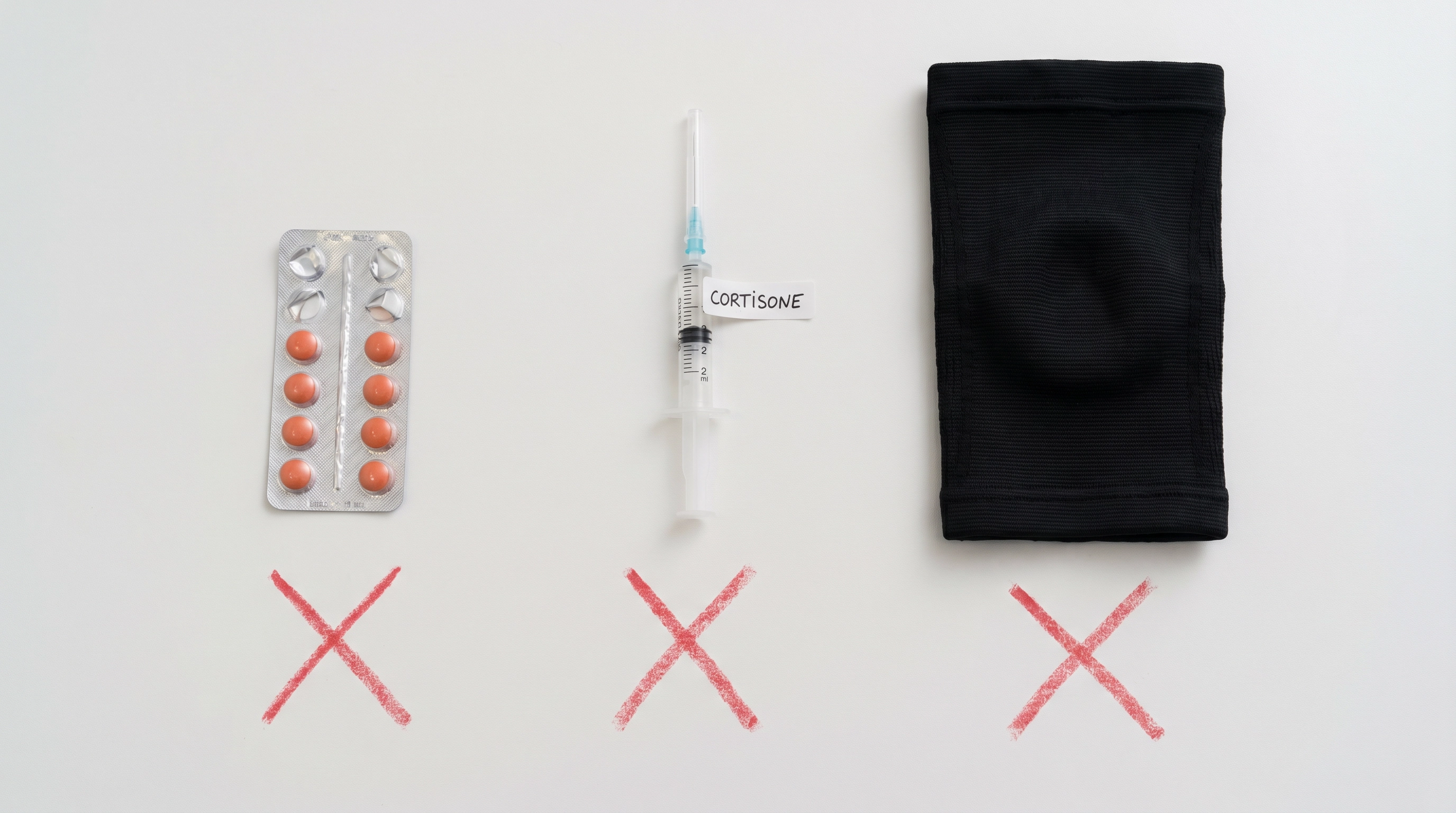
The ibuprofen.
NSAIDs chemically inhibit the synthesis of glycosaminoglycans, the building blocks the body uses to repair cartilage.
The pills I had told Margaret were safe were shutting down her own repair system at the cellular level.
The cortisone shots.
Cortisone weakens cartilage. Documented for decades.
The reason each shot works for less time is not that the body is getting used to it. The shot is silencing the alarm while the damage continues.
Each round, less cartilage left to send the signal from.
The compression sleeve I had recommended at the front desk for 30 years.
Squeezes the joint harder. Less space inside. Less fluid. Faster starvation.
The arthroscopic procedure I had performed 400 times.
The BMJ panel had said it performed no better than exercise therapy.
The total knee replacement I was about to send my wife into.
Does not feed the cartilage. Removes the joint and replaces it with metal that lasts roughly 15 years.
Not the cure. The destination.
Every step of the protocol I had spent 42 years on was accelerating the disease while billing the insurance for the privilege.
Right diagnosis. Wrong target. Every single time.
What The 1940s Knew Before We Forgot
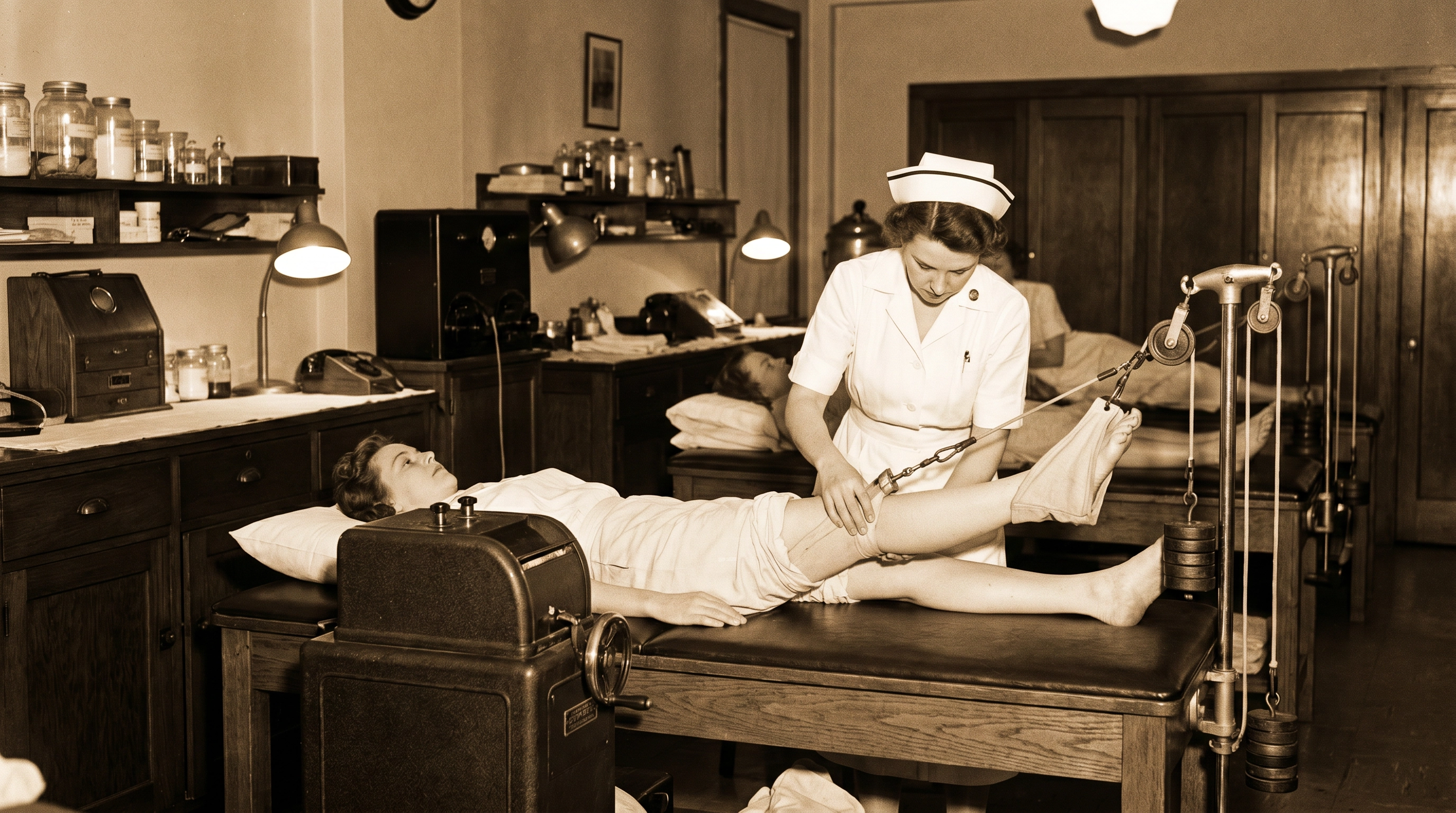
There is a treatment older than my entire career.
Joint distraction therapy. Mechanical decompression.
Used in physical therapy clinics since the 1940s.
Lift the femur off the tibia by a few millimeters. Create measurable space inside the joint.
When that space opens, negative pressure pulls the synovial fluid back into the loaded zone where it has been squeezed out for years.
The cartilage gets fed for the first time.
Studies on joint distraction have shown measurable cartilage thickness increases on MRI. Pain reduction averaging 66% compared to 16% for standard physical therapy.
I had known about it since residency. We had used it occasionally.
Then it had quietly disappeared from the standard of care.
Cortisone. Billable. NSAIDs. Billable. Arthroscopy. Billable. TKR. Highly billable.
Joint distraction. Not billable.
It had been edged out of the protocol by the codes. Not by the evidence.
What I Could Not Find On The Market
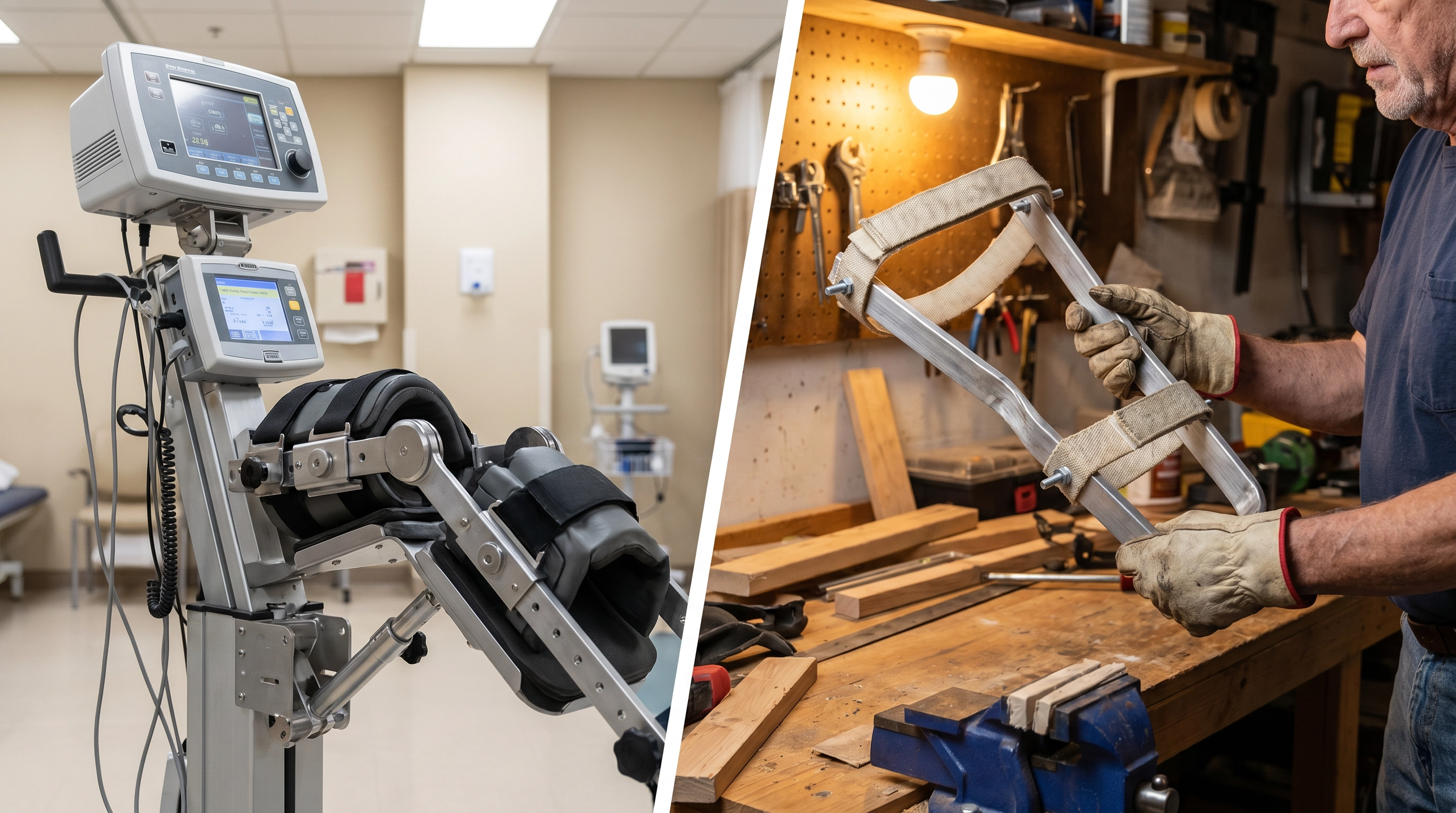
The clinic equipment cost $2,000 to $4,000. Required a prescription. Required a physical therapist to operate.
There was nothing on the market that did what the clinic equipment did at a price a retired teacher could afford.
I called an old friend from medical school who had moved into biomedical engineering.
He had a prototype in three weeks.
The first version was ugly. Aluminum bars and elastic straps held together with industrial Velcro.
Margaret laughed when I held it up. Then she put it on.
She felt the lift immediately. Said it was the first thing in three years that had not made her knee feel more squeezed.
The next morning she got out of bed in eight minutes. Not twenty.
We went through eleven prototypes over fourteen months.
We measured joint space change on Margaret's follow-up X-rays. Three millimeters of separation. Documented.
By prototype eleven we had something that did what the $4,000 clinic equipment did.
Same mechanism. Same measurable effect on joint space.
At household price.
We called it clinical-grade axial decompression because that is what it is.
What Happened With Margaret

I cancelled her surgery three days before the scheduled date.
Day five she walked to the end of our street and back without limping.
Day twelve she sat on the floor with our grandson and built a Lego pirate ship. Forty minutes.
She got up without leaning on the coffee table.
He did not notice anything. Our daughter walked in from the kitchen and stopped in the doorway. She did not say anything for a long time.
Day nineteen she slept through the night for the first time since 2021.
Day twenty-six she walked to the mailbox in her garden shoes and stayed outside for an hour.
The First Phone Call

In April I called Linda. She had been my patient for six years.
Three cortisone injections. TKR scheduled in May.
I had been the one to recommend it.
I told her what I had found. I sent her a brace that week.
Three weeks later she called from her kitchen and said she had walked the dog that morning.
She had not walked the dog in two years.
The next month I sent eight more.
By July I was sending a prototype a week.
The Calls That Stopped Coming
I attended the conference in November.
Two surgeons I had trained alongside for twenty years walked past my table without making eye contact.
A third stopped and asked what I was doing now.
I told him.
He nodded slowly and said Walter, I have a daughter starting college this year. I cannot afford to think about this right now.
I was not surprised. I had been on the other side of that conversation in my forties.
I am not telling you my old colleagues are villains. I prescribed the same protocol myself for 42 years.
The system was simply never built to ask the right question.
The right question is not how aggressively do we manage the symptoms.
The right question is are we relieving the compression that is starving the cartilage in the first place.
For 42 years I never asked it.
The Patients Who Said Yes

Linda, 64. Three cortisone injections. TKR scheduled. Walked the dog after three weeks.
Frank, 71. Six months post-meniscus surgery, pain worse than before. Two and a half weeks. Played catch with his grandson in the backyard.
Dorothy, 68. Two failed cortisone rounds. Eighteen days. Stood at her stove and made a full Sunday dinner. First time in fourteen months.
Margaret has now been off all knee medication for fourteen months.
She walks four miles on Sunday mornings. She sits on the floor with our grandson. She gardens.
Not everyone responds in the same timeframe. Some notice changes in days. Others take three to four weeks.
But the pattern is consistent.
When the joint gets decompressed and the synovial fluid finally reaches the cartilage, the body does what 42 years of orthopedic protocol could not make it do.
It starts to heal what was never worn out. Just starved.
Why Nobody Told You

There is no billing code for clinical-grade decompression at home.
A cortisone injection generates $1,600 every three months. A TKR generates $43,000. A revision surgery 12 years later generates another $43,000.
A peer-reviewed paper showing 66% pain reduction from joint distraction generates nothing.
So it sits in the journals.
Your doctor was not wrong to follow the protocol. They were doing what they were trained to do inside a system that pays for certain interventions and does not pay for others.
The codes determined the protocol.
The protocol determined your path.
The path ends at the operating room.
I had not asked the right question for 42 years.
Most of them have not yet.
Two Roads
❌ Path One: Keep Following The Protocol
Pills that triple your odds of surgery.
Shots that work for less time each round.
A sleeve that squeezes the joint harder.
The surgery date on the calendar.
✅ Path Two: Address The Compression
Lift the femur off the tibia by a few millimeters.
Let the synovial fluid reach the cartilage that has been starving for years.
Same mechanism used in physical therapy clinics since the 1940s.
The price is what changed.
90-Day Money Back Guarantee · Fast Free Shipping · No Subscription Required
My 90-Day Guarantee
My Personal 90-Day Guarantee
I am 78 years old. I have nothing left to prove.
Use the brace for 90 days.
If you do not feel a meaningful difference in your pain, your sleep, and your ability to move, every penny back.
No forms. No phone calls. No questions asked.
I am not worried about the guarantee.
The patients who address the compression at the joint level get better. That is what 42 years of incorrect protocol followed by three years of correct protocol have shown me.
You have already spent years following a protocol that was making the disease worse.
You have 90 days to find out what happens when the joint finally gets to decompress.
90-Day Money Back Guarantee · Fast Free Shipping · No Subscription Required
★★★★★ 4.8/5 from 4,316 Reviews

Eder Dionizio
I've had knee arthritis for 8 years. Three cortisone shots and they kept telling me surgery was the next step. Got this brace two weeks ago and I walked my dog for the first time in two years this morning. I can't explain it but I can feel the difference immediately when I put it on.

Lucia West
Can someone vouch for this? My doctor just told me I need a TKR and I'm terrified 😟

Roberval Campbell
Yes I can vouch. Was scheduled for TKR in March. Started using this in January. Cancelled the surgery. My surgeon was not happy but I don't care — I'm walking without a cane for the first time in 18 months.

Ligia Thacker
Slept through the night for the first time in three years. I put it on before bed and the pressure just... releases. My husband said I stopped waking him up at 3am. 😍

Marcelo Essado
Six cortisone shots over three years. Each one worked for less time. This is the first thing that actually addressed why the shots were wearing off faster. Three weeks in and I'm pain free in the mornings.

Valquiria Machado
My gastroenterologist told me to stop ibuprofen — my stomach was destroyed. Had nothing left for the knee pain. This saved me. Two weeks and I'm off all medication.

Jaqueline Gerber
I sat on the floor with my grandkids for the first time in two years. Got up without help. My daughter cried. I cried. Worth every penny 💖
P.S. Margaret is in the garden this morning. She has been out there for an hour. Three years of pills, three cortisone shots, and a scheduled TKR never gave her that morning. The brace did.
P.P.S. Every brace is still made in small batches in Michigan. We are not on Amazon. We are not in pharmacies. The last time we ran out the waitlist was five weeks.
P.P.P.S. I do not see patients anymore. I am not affiliated with my old practice. I am not paid by any pharmaceutical company or device manufacturer. The only reason this paper exists is that 42 years of doing it the wrong way is enough.
Check Availability →