

Rheumatologist Warns: I've Treated Over 8,000 Americans With Fibromyalgia, and Your Pain Has Nothing to Do With Stress

What a rheumatologist discovered when his own wife was handed the same diagnosis, and the 15-minute evening ritual that has already released the clamp for over 11,500 women.

The Real Reason Your Fibromyalgia Treatments Keep Failing
If you've been managing fibromyalgia for more than six months, trying the medications, the supplements, the diets, and you're still not meaningfully better, I want to share something before your doctor recommends the next step.
The treatment you've been receiving may be targeting the wrong place entirely.
That place is your neck. And before you ask how a neck could explain pain in your hips, your hands, your sleep and your memory: that question is this whole article. By the end of it you will know exactly why the pain everywhere else is the echo, and the neck is the source.
I've spent 27 years as a rheumatologist. I've sat across from over 8,000 women with widespread pain, crushing fatigue, and fog so thick they lost words mid-sentence.
And for twenty-one of those years, when the tests came back normal, I wrote one word on their chart.
Fibromyalgia.
It sounds like an answer. It isn't. It's what we write when we've run out of places to look. A big word that sounds like a solved mystery, handed over with an antidepressant and a "see you in six months."
If no one has ever apologized for that, let me be the first. Because what I found when I finally started looking again made me leave my practice.
The Night It Came Home
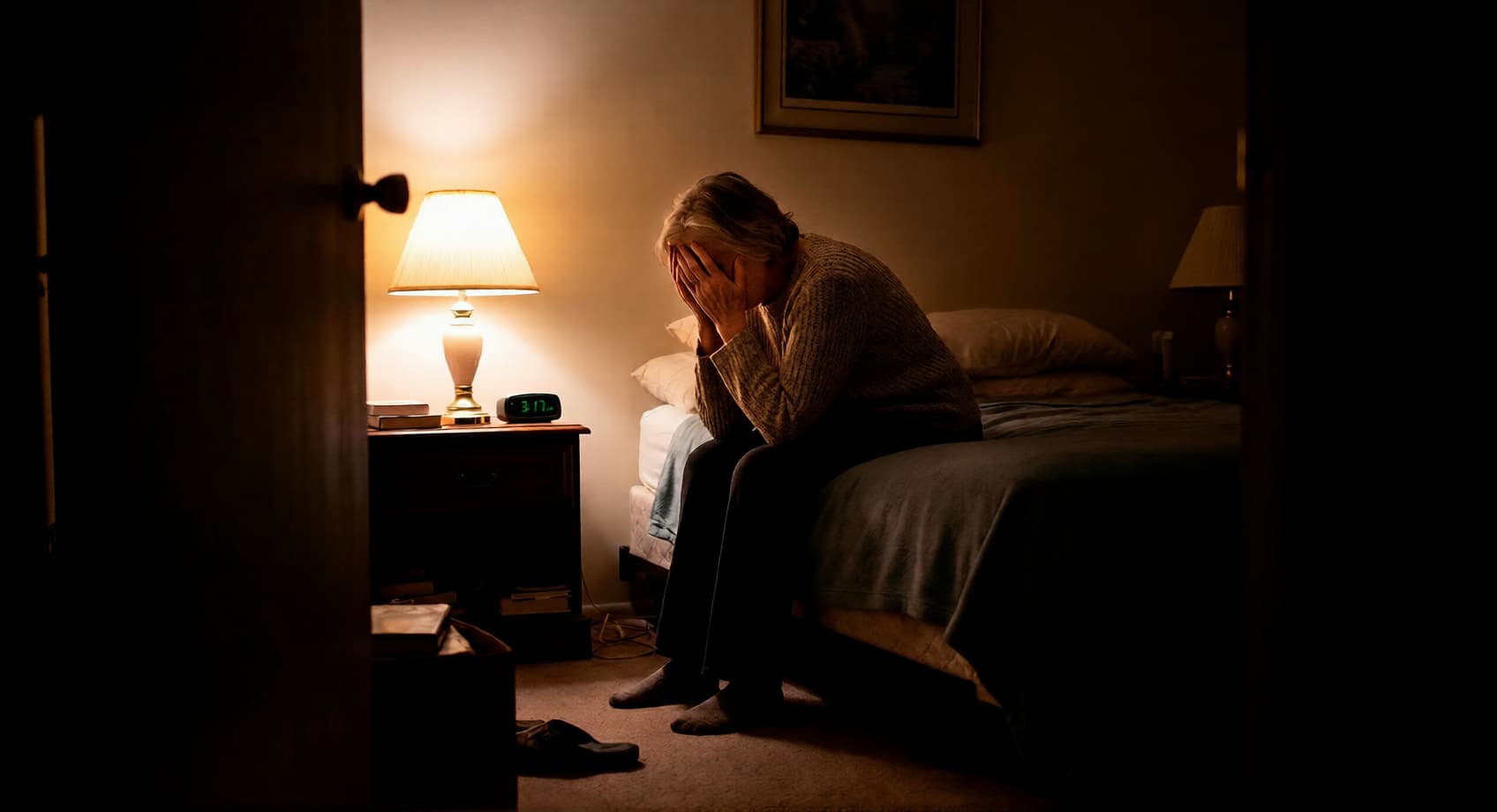
Twenty-one years into my career, my wife Carol started describing the same symptoms I had been filing away on other women's charts for two decades.
Pain that moved without a pattern. Mornings spent scanning her body before her feet touched the floor. Fog so thick she would lose a word mid-sentence and laugh it off, then cry about it later.
For ten years, I watched her run the same gauntlet my patients ran. Four specialists. Normal bloodwork. Normal imaging. Words like stress, anxiety, perimenopause.
Then one afternoon, after the fourth specialist suggested she try journaling, I sat with her in the car. And it hit me.
I had written that same recommendation, in different words, on thousands of charts.
Everything my training told me to do had done nothing for the woman I love. And if the protocol was useless for her, it had been useless for every woman I had ever handed it to.
So I did what I should have done twenty years earlier. I stopped following the protocol, and I started reading the diagnosis itself.
Your Diagnosis Had The Map Printed On It Since 1990
Here's what most patients are never told.
When the fibromyalgia criteria were formalized in 1990, doctors mapped 18 tender points on the body.
Eight of the eighteen sit on the neck and shoulders. Two of them exactly at the base of your skull, two on the lower sides of your neck, two on the tops of your shoulders, two on the muscle above each shoulder blade.
Not your hips. Not your knees. Not your hands. Nearly half of the exam for a "body-wide" disease, on one place. The one narrow pass every pain signal in your body must cross to reach your brain.
The answer was printed inside your diagnosis for 35 years. Nobody read it to you. Including me.

And here is the strongest clue researchers ever found about where this condition lives. A controlled study published in my own specialty's journal followed 161 people after an injury. Fibromyalgia developed thirteen times more often after a neck injury than after a broken leg.
Not because everyone with fibromyalgia had an accident. Most of the women I treated never did. Because the neck is where this thing lives, and an injury just gets it started faster. You don't need a crash. You just need the exam you already had.
The Point Everything Passes Through
Every pain signal from every inch of your body, your legs, your back, your shoulders, your hands, travels up through your neck to reach your brain. Like an entire city's traffic crossing a single bridge.
Right at that pass sit the most densely innervated small muscles in the human body.
In fibromyalgia, those muscles are clamped. Locked. Sometimes for years.
And a clamped pass doesn't just block the signals. It amplifies them. Every message that crosses arrives at your brain distorted and louder, like a microphone held too close to a speaker.
That's why a light touch burns. Why your bedsheet can feel like sandpaper. Why the pain moves around and never stays where you last felt it.
You don't have pain in fifteen places. You have one clamped point turning up the volume on all of them.

The Cycle That Keeps You Stuck
Pain, guarded neck muscles, broken sleep, an unrepaired pain filter, louder signals, more pain.
Your pain filter repairs itself during deep sleep. That's the night shift. But a clamped neck sends danger signals all night long, so your body never allows deep sleep to start.
You can sleep ten, twelve, fourteen hours and wake up like you never slept. The repair shift never clocked in.
Researchers in Toronto proved this direction in 1975, in a sleep lab. They took healthy volunteers with no pain at all and interrupted their deep sleep for a few nights, without fully waking them. Within days those healthy people had aching muscles, tender points in the same spots as fibromyalgia patients, and the fog. Then the researchers let them sleep, and it went away.
Nobody is waking you from a chair in a lab. Your own neck is doing it, every night.
And there's a second problem. Your brain clears its waste during deep sleep, through a drainage system that runs down through your neck. Researchers call it the glymphatic system. A clamped neck is a closed drain. So every night the clamp stays locked, the filter goes unrepaired, and the waste backs up into tomorrow's fog.
Now here is what that costs, because nobody in a fifteen-minute visit will ever tell you.
In 2007, researchers at McGill University put women with fibromyalgia in a scanner and measured their brains against healthy women the same age. The results were published in the Journal of Neuroscience. Women with fibromyalgia were losing gray matter more than three times faster. And on the scan, each year of fibromyalgia showed up as nine and a half years of normal brain aging.

Read that the way I had to read it, as a husband and not as a doctor. Nine and a half years, for every year you're told to live with it. That's what "learn to live with it" actually costs. It isn't patience. It's a meter.
And the meter runs every night the night shift doesn't clock in, because deep sleep is exactly when the brain gets cleaned and repaired. Skip it for years, and the scanner shows what McGill saw. Not because the brain is diseased. Because the crew never came to work.
Here is the part of that research nobody quotes. Other scanner studies found the gray matter comes back when the pain goes. The brain isn't a bill you can't reverse. It's tissue that repairs, once you let it sleep. The meter runs both ways.
Why Nothing You Tried Ever Worked
Every medication you've been handed works downstream. On your pain filter. After the signal has already been amplified.
That's like turning down the stereo while someone keeps twisting the volume knob back up.
The Lyrica helps, then the dose climbs. Then it climbs again. Twenty pounds and a fogged memory later, the clamp is still there, doing what it does every night.
Meanwhile, imaging studies tell a story your bloodwork never could. In fMRI research, fibromyalgia patients show measurably amplified pain responses. Your pain is visible on the right machine. It's real, it's physical, and it's been documented for years.
It's not that you failed the treatments. The treatments were aimed at the wrong address. Nobody was treating the clamp. They were medicating the echo.
It's Not A Disease. It's A Deficiency.
This is the one thing my profession will never say out loud, so I'll say it.
Fibromyalgia is not a disease. We treat it like one. We bill for it like one. We schedule refills for it like one.
But it's not. It's a deficiency. A body that hasn't run its repair shift in years, because the muscles at the base of the skull never let it. And no pill in the world fixes a deficiency. A pill can muffle the alarm for a few hours. It cannot run one minute of the night shift.
You can't put a billing code on a body doing its own repairs. That is why the fix was never offered to you, and why the refill always was.
That's the opening for a genuinely different approach.
The Discovery That Changed Everything
After what happened to Carol, I stopped reading drug trials and started reading engineering papers. My son Daniel is a biomedical engineer. For two years, our garage looked like a research lab.
What we found was hiding in plain sight. Medical-grade red light, at two exact wavelengths, 660 and 880 nanometers, penetrates up to two inches below the skin. Deep enough to reach the clamped points at the base of the skull. It is one of the only technologies with published studies in fibromyalgia patients, and it does what no pill can: it feeds the clamped tissue until it can finally let go.
But red light alone was not enough. Clamped tissue relaxes immediately under constant, targeted pressure. And clamped nerves release faster when they are warmed. Pressure. Warmth. Red light. In that order, together, the clamp lets go.
The Treatment Reserved For People Who Can Afford It
Here is the part that made me angry. This therapy already exists. It has existed for years, inside high-end clinics.
One session runs about $300. And you need it daily, because the clamp re-tightens every night while you sleep. That is $9,000 a month. Before the drives, the gas, the parking, the waiting rooms.
Ever wonder why the celebrities who go public with fibromyalgia seem to live normal lives? They travel. They work. They smile on morning shows. This is how. They are not stronger than you, and their pain was never smaller than yours. They can afford $9,000 a month, every month, forever.
You were never offered that door. You were offered Lyrica in a six-minute visit, because it is cheaper than actually helping you.
So My Son And I Built It Ourselves
A clinic machine is the size of a refrigerator because nobody ever bothered to make it small. We spent two years doing exactly that.
Every diode inside our device is microscopic, engineered at the exact power needed at 660 and 880 nanometers to reach two inches deep. The massage phase holds constant, targeted pressure on the clamped points, deeper than any pair of hands, and it never gets tired. The warmth phase floods the tissue, so the clamped nerves soften and the drain reopens.
We named the mechanism the Medical Red Light Triple Action. Three phases, one 15-minute evening session, lying on your own couch.
Phase 1: Release
Deep, targeted massage pressure on the clamped points at the base of the skull. Fibromyalgia patients consistently report that intense pressure is the one thing that brings real relief. This delivers it, engineered and constant, exactly where the clamp lives.
Phase 2: Drain
Therapeutic warmth softens the clamped tissue and reopens the passage. Blood flow returns to tissue that has been starved for years, and the neck's drainage pathway can finally open, so the night shift can start again.
Phase 3: Recharge
Medical red light at 660 and 880 nanometers reaches two inches deep, feeding the starved tissue at the clamped points. Without this third phase, the clamp tightens back up between sessions.
Miss any one of these phases, and you are only partially addressing the problem.

The device is called the RedLight Pro. The first prototype sat on our kitchen table. Carol was the first person on earth to use it.
What The Research Confirms
The physiological basis for each phase is established.
The tender points at the base of the skull have been part of the official fibromyalgia criteria since 1990. The Toronto sleep experiments showed, in healthy volunteers, that blocking deep sleep produces the condition, and that restoring it reverses it. Research into the brain's glymphatic drainage system, one of the most important neuroscience discoveries of the last decade, confirms it works almost exclusively during deep sleep, and that it drains through the neck. And a 2019 meta-analysis of red light therapy in fibromyalgia patients found meaningful improvements in pain and quality of life.
The evidence has been there for years. What hadn't existed was a practical device that delivered all three phases together in a single 15-minute evening session at home.
"In a recent survey of RedLight Pro users, 93% felt the clamp release in their very first session, and 84% reported sleeping through the night within the first two weeks."
What Happened To My Wife
Night one, Carol used it for fifteen minutes on the couch, then went to bed. The next morning she slept until 6:40. She had not slept past 5 a.m. since 2019.
Week one, she stopped doing the inventory. She opened her eyes and simply got up. No scanning. No negotiation with her own body.
Week two, she was sleeping through the night. Full, deep, boring sleep. The kind you forget exists.
Week three, she made pancakes on a Tuesday and called our daughter. They talked for an hour. She never lost a word.
Week four, she booked a flight to see her sister. A suitcase. Plans. All the things fibromyalgia had taxed out of her life, she started taking back, one by one.
The diagnosis is still on her chart. The life that came with it is not.
Then Her Yoga Group Found Out
Carol goes to a yoga group on Thursdays. For years she sat in the back and left before the final stretch. Six weeks in, she stayed for coffee.
Her friends noticed. Then they asked. Then they wanted one. Then their sisters wanted one, and their daughters were calling me from three states away.
We could not build them fast enough in a garage. So I partnered with Revive Care, a bio-tech company in California that sources medical-grade red light components. They believed in the mechanism, took over manufacturing, and made it possible to sell directly online. No clinics, no middlemen, no $9,000 months.
Try RedLight Pro Risk-Free | 90-Day GuaranteeWhat Women Are Experiencing
"I rolled my eyes at first. I'd been burned by every headline there is. But my doctor pressed those exact tender points in 2003 and never mentioned them again. That got me. Three weeks later I woke up and there was nothing to scan. I made pancakes like a normal person and cried."Darlene, 54 ★★★★★
"Twenty years of this. Nothing works on me. But the first session, around minute six, I felt something let go at the base of my skull. Like a fist unclenching after twenty years. Week four, I was walking my dog before breakfast. I kept waiting for the catch. There isn't one."Glenda, 61 ★★★★★
"I'm 67 and on three medications. I didn't have to stop anything. Two weeks in, I slept through the night for the first time in years. My husband thought something was wrong."Eileen, 67 ★★★★★
"My brain fog is the worst part. Week three, I finished a sentence without searching for the word. Then I finished a whole book. I hadn't done that since my forties."Nadine, 45 ★★★★★
"I have no energy for one more thing. That's the point. You lie down and it does the work. It's the first treatment that gives me spoons instead of taking them."Rosa, 49 ★★★★★
The Letters Started Arriving
Since we launched, I have received four formal letters demanding we pull the device from the market. It has no billing code, they say. It is not an approved protocol, they say.
Our attorney read them and laughed. Letters like these are never about safety. They are about revenue. When a $9,000-a-month patient walks out the door holding a $49 device, someone, somewhere, stops getting paid.
I recognize the playbook because I spent twenty-one years inside it. I was the one prescribing the loop. They do not want you out of it, because the loop is the business model.
Then a sales team that rents red light equipment to clinics called us directly. Their complaint was almost honest: at this price, they said, you are destroying the perceived value of red light therapy.
They are right. We are. Because perceived value never released a single clamped nerve.
We do not care about protecting margins. We care that women like my wife, women losing years of their lives, get them back without absurd costs, without a system that medicates the echo, without being treated like psychiatric cases.
That is why the current batch sells at $49 instead of $229, 78% off, while units last. And I will be straight with you about the future. We launched four months ago, and a new cease-and-desist arrives roughly once a month. Revive Care keeps sourcing components and shipping orders, but if one of these letters lands in the wrong courtroom, this page disappears along with the stock.
>>> GET 78% DISCOUNT BEFORE THIS BATCH IS GONE <<<The Line You Don't Want To Cross
There is one more thing, and it is the reason I don't tell anyone to think about it for a few months.
An alarm that rings long enough eventually stops needing a reason. The nervous system learns the pain. Researchers call it central sensitization: the wiring itself changes, and the amplified signal becomes the new normal even when nothing is pressing the clamp anymore.
The women who came to me after a decade of refills took the longest to bring back. Not because the clamp was different. Because there was more wiring to undo. And the meter from McGill does not pause while you decide.
I watched my own wife walk right up to that line. Every year you are told to live with it is a year closer to it.
My Honest Recommendation
Take 90 days. Use it every evening, fifteen minutes on the couch. Most women feel the clamp release in the very first session, around minute six. That is the mechanics. The deeper changes, the full nights, the mornings without the inventory, the word that comes on the first try, build over two to four weeks as the night shift comes back online.
If it does not work for you, we do not want your money.
Call the number you will find on the next page, or send one short email, and within 48 hours the refund is back in your bank account. And you keep the device. Nobody will ask you to find a box, print a label, and stand in line at a shipping office. You have been through enough already.
I can put terms like these in writing because I know what the mechanism does. And I know exactly where the first unit ever built is sitting. It is on my wife's side of the couch, and it is not moving.
>>> Claim Your RedLight Pro 78% Off <<<Try It Risk-Free Tonight
It is not sold in pharmacies or on Amazon. It's sold directly, to keep quality control and to offer a full 90-day money-back guarantee.
Path 1: Continue what hasn't been working.
More dose increases. More heat packs that die in twenty minutes. Temporary relief, while the clamp keeps doing its work every night, quietly, in the one place nobody checks.
Understand what waiting actually costs. Not money. Tonight. Every night the clamp stays locked is one more night your filter goes unrepaired, one more morning that starts with the inventory. The clamp does not take nights off. Neither should you.
Path 2: Give your body the night shift it's been starving for.
Fifteen minutes in the evening. All three phases working together. The first approach that treats the point everything passes through, instead of medicating the echo.
You were never crazy. It was never in your head. It was your neck.
The next step is yours.
90-Day "Quiet Mornings" Guarantee. Use it every evening for up to 90 days. If it does not work for you, one call or one email, and the full refund is in your bank within 48 hours. You keep the device. No forms, no questions, no return label.

👉 Secure yours tonight: feel the clamp release around minute six, or you pay nothing
Click Below To Secure Your Device With 78% Off While Supplies LastReference List:
1. Wolfe F, et al. The American College of Rheumatology 1990 Criteria for the Classification of Fibromyalgia. Arthritis & Rheumatism, 1990.
2. Moldofsky H, et al. Musculoskeletal symptoms and non-REM sleep disturbance in patients with "fibrositis syndrome" and healthy subjects. Psychosomatic Medicine, 1975.
3. Buskila D, et al. Increased rates of fibromyalgia following cervical spine injury: a controlled study of 161 cases of traumatic injury. Arthritis & Rheumatism, 1997.
4. Kuchinad A, et al. Accelerated brain gray matter loss in fibromyalgia patients: premature aging of the brain? Journal of Neuroscience, 2007.
5. Xie L, et al. Sleep drives metabolite clearance from the adult brain (glymphatic system). Science, 2013.
6. Meta-analysis of photobiomodulation (red light) therapy in fibromyalgia patients. Lasers in Medical Science, 2019.
7. Gracely RH, et al. Functional magnetic resonance imaging evidence of augmented pain processing in fibromyalgia. Arthritis & Rheumatism, 2002.
- All 3 phases in one 15-minute session
- 660 + 880nm red light, warmth and deep massage
- Feel the clamp release the first evening
- Sleep through the night within 2 weeks
- 90-Day Guarantee: refund in 48h, keep the device